The Sim-to-Real Gap of Foundation Model Agents: A Unified MDP Perspective
Xiaoou Liu*, Tiejin Chen*, Weibo Li, Xiyang Hu, Hua Wei
KDD’26 Blue Sky Track
[Paper]
TL;DR
Foundation model agents often look impressive on benchmarks yet stumble in real deployment. This is not a new mystery but a form of the classic sim-to-real gap long studied in reinforcement learning. By formalizing both benchmarks and deployment within a unified MDP framework, we identify four channels through which this gap emerges and connect each channel to established remedies.
Motivation
An LLM agent today does more than chat: it calls tools, reads results, and takes actions to finish tasks. These agents achieve high scores on tidy benchmarks where inputs are clean and failures are cost-free. However, in deployment, they face noisy multilingual requests, tools that time out or return malformed data, and real costs in money and latency. A high leaderboard score says little about whether an agent will hold up in the wild.
The community keeps encountering these failures one at a time, but lacks a shared vocabulary for discussing them. We propose to change that.
Key Idea: Four MDP Channels
Reinforcement learning calls this the sim-to-real gap, which is the performance drop when a policy trained in simulation meets the messier real world. We bridge this to LLM agents by describing both settings with a Markov Decision Process (MDP). The four core elements, Observation, Action, Transition, and Reward, define four channels through which the gap can emerge:
-
Observation Gap. The agent’s inputs drift through typos, paraphrases, or language switches. This is the perception mismatch that robotics handles with domain randomization and adaptation.
-
Action Gap. The set of available tools is crowded with near-duplicate or distracting options, answered by action shielding that filters unsafe or invalid calls.
-
Transition Gap. Tools time out or return broken responses — the dynamics mismatch addressed by grounding methods that make simulated tools behave like real ones.
-
Reward Gap. A plain accuracy score ignores hidden fees and latency. Reward shaping and augmentation can fold these real-world costs back in.
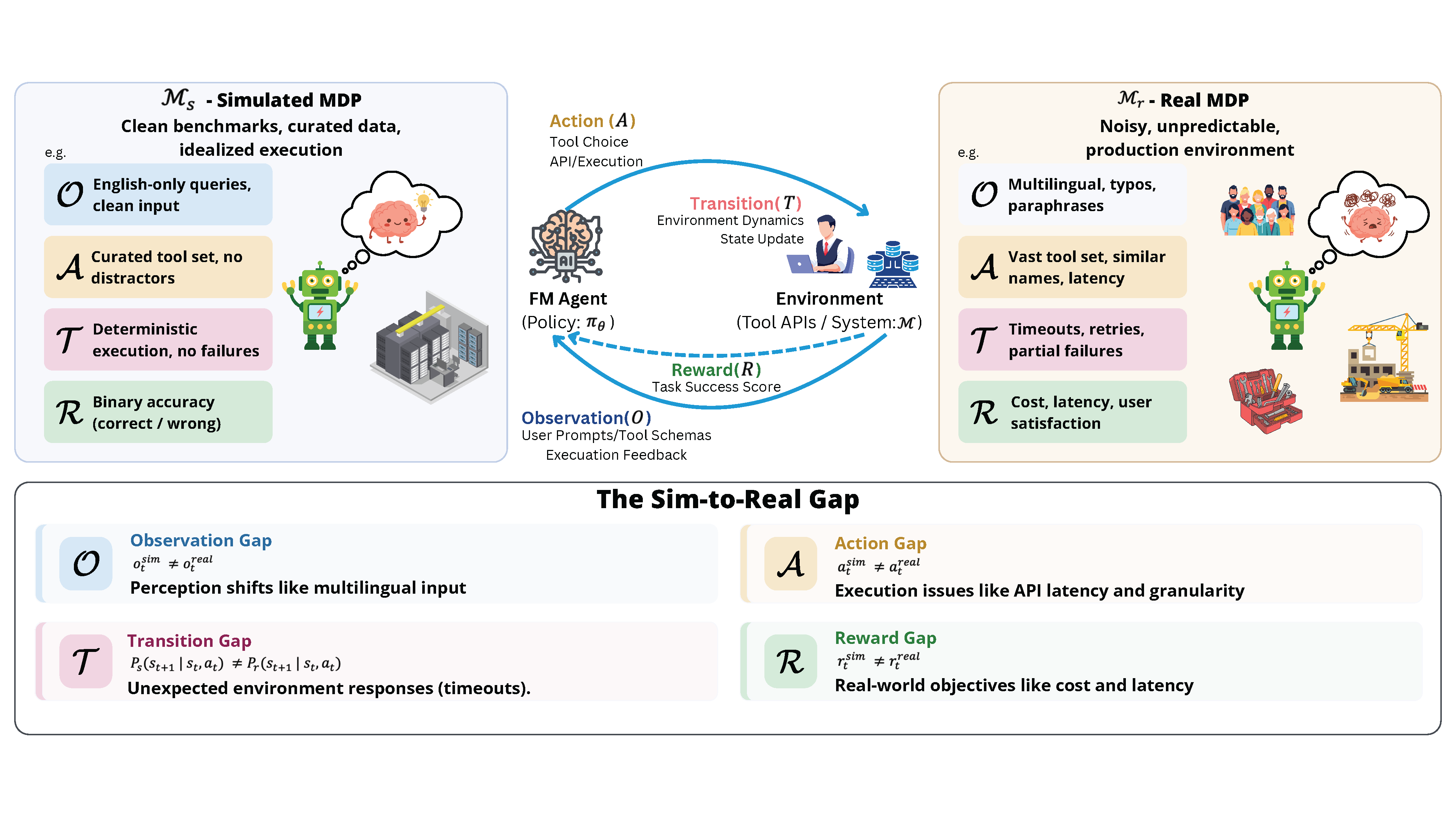 Overview of the four MDP channels through which the sim-to-real gap manifests in foundation model agents.
Research Agenda
Reading the gap through these four channels suggests a concrete research program:
- Build stress-test benchmarks that inject controlled noise into each channel, rather than testing only on clean inputs.
- Share perturbation recipes so results are comparable across groups.
- Design training that randomizes these conditions so robustness is learned rather than hoped for.
Takeaway
Agent robustness already has a science behind it. Naming the failure as a sim-to-real gap over four MDP channels gives the community one shared language, a set of ready remedies, and an honest way to measure trustworthiness before deployment.